Key takeaways
- ✦Diagnosis and a strand test come before any product.
- ✦Processing needs 40–60 minutes once fully distributed.
- ✦Thermal sealing — temperature, passes, section size — decides gloss versus rubbery hair.
1. Diagnosis and strand test
Assess porosity, elasticity, density and previous chemistry. Bleached hair requires a strand test; chemically damaged, elastic hair should be reconstructed before realignment.
2. Cleansing
A cuticle-opening pre-treatment shampoo removes residue so actives penetrate rather than sit on the surface. A harsh clarifier is a diagnostic decision, not a default.
3. Application and processing
Apply section by section with fine, even distribution. Then process for 40 to 60 minutes — never 20, regardless of how the hair looks. The reaction is chemical, not visual.
4. Rinse and blow-dry
Rinse as your manual specifies and blow-dry the hair 100% dry with a quality brush or comb.
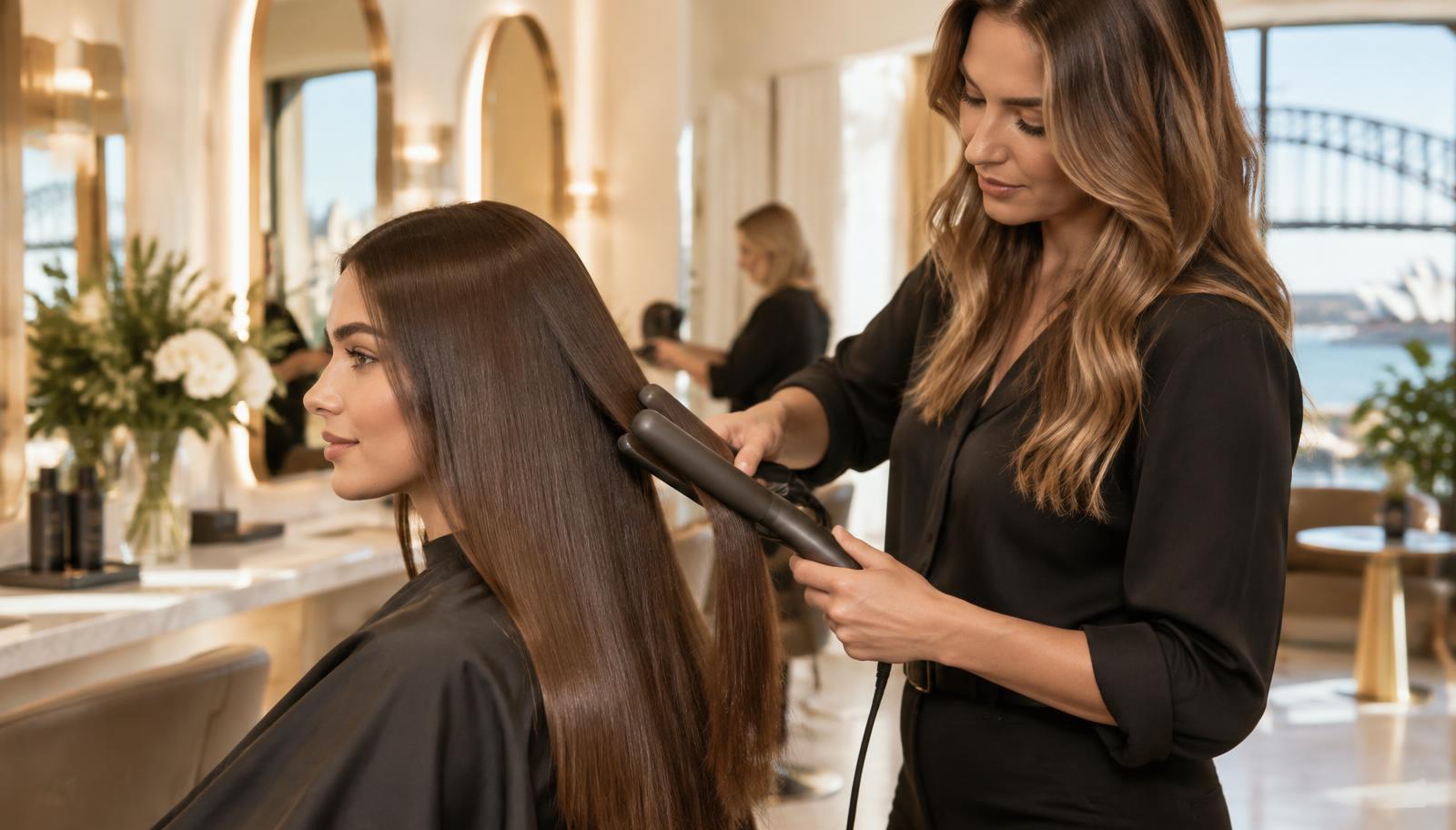
5. Thermal sealing
Flat iron fine sections at the temperature and number of passes set by the manual. This step evaporates residual water, fixes the alignment and seals the cuticle.
How should a stylist prepare the technical plan before application?
The stylist should prepare a written technical plan before application by combining consultation findings, representative strand testing and the current manufacturer instructions. This expansion clarifies the working parameters: processing is 15–60 minutes depending on hair type and formula, not a universal minimum of 40 minutes. The exact selection must come from the Vitta Gold Education Manual rather than a fixed salon habit.
Map density, porosity, strand thickness, curl pattern and previous colour as separate observations. A dense head may require more working time without needing the same settings as another dense head. Identify lightened areas, overlapping chemical histories and any uncertainty that affects whether to proceed. For curly clients, record the agreed finish and discuss how the service may alter visible movement rather than assuming maximum straightness is always the goal.
Plan enough uninterrupted time for each stage and make the relevant instructions accessible at the workstation. Confirm that required equipment is clean, functioning and suitable for the task. If the salon uses an assistant, define their role and handover points before starting. The technical plan should remain specific to the individual appointment; a familiar service name, hair colour or previous successful booking is not a substitute for the current assessment.
What makes a strand test useful for the full service?
A useful strand test represents the hair being treated and reproduces the intended process closely enough to support a professional decision. Select an area that addresses the main uncertainty rather than choosing only the strongest-looking hair. Where natural regrowth, coloured lengths and bleached ends differ substantially, the assessment may need to consider more than one representative zone as directed by the manual.
Record the starting condition, product application, processing selection, rinse instruction, drying and thermal settings used for the test. Evaluate the completed result rather than judging only how the strand feels during application. The aim is to decide whether the proposed process is appropriate and whether the intended finish is realistic. It is not a competition to obtain the straightest possible result from an isolated section.
Explain the findings to the client in ordinary language. If the assessment does not support proceeding, revise or postpone the service rather than trying to compensate with an improvised processing time. For bleached hair, do not assume a lower temperature alone resolves every concern. Refer to the Vitta Gold Education Manual for the complete decision pathway and exact protocol. Keep the test notes with the consultation record so the full-service plan has a clear, reviewable basis.
How should sectioning support consistent application?
Sectioning should support even distribution and controlled access to the hair rather than follow one fixed width for every client. Begin with an organised head map, then subdivide according to density, strand characteristics and the application instructions. A section that looks manageable on fine hair may conceal substantial bulk on a denser head, making even work more difficult.
Work systematically so completed and uncompleted areas remain clear. Follow the manual for the amount of product, application placement and distribution method. Avoid loading additional product simply because an area is curly or feels porous. More product is not a reliable substitute for assessment or careful distribution. Keep notes where a mixed history requires particular attention, especially around highlighted hairlines and previously lightened ends.
Track timing exactly as the Vitta Gold Education Manual specifies, including how the processing period relates to application. The permitted processing range is 15–60 minutes depending on hair type and formula; do not shorten or extend it based only on visual impression. If an assistant helps, agree on a clear section map and timing responsibility. Consistency comes from controlled execution, not from making every head fit the same section size or using the same clock setting regardless of the assessment.
How should rinsing and complete drying be verified?
Rinsing and drying should be verified against the exact protocol, with 60–100% of the product rinsed and the hair then blow-dried 100% dry. The rinse range does not give the stylist permission to choose a convenient midpoint. The Vitta Gold Education Manual determines the required removal for the particular hair and formula, and that instruction should be recorded before the client reaches the basin.
Distribute the rinse carefully through dense areas and avoid assuming that the surface represents the whole head. Do not deliberately retain more product in the hope of obtaining a stronger result. Equally, do not replace the instructed rinse with a different routine remembered from another service. When an assistant completes the basin stage, the handover should state the exact requirement rather than simply asking for a quick rinse.
During blow-drying, organise the hair into workable sections and check the nape, roots and dense interior areas. A dry-looking exterior does not confirm that every area is fully dry. Resolve residual moisture before flat-ironing; the thermal stage must not be used to finish drying the hair. This checkpoint deserves its own time allowance. If the appointment is running late, adjust the booking schedule rather than skipping verification or rushing directly from the basin into thermal work.
How should stylists control the thermal stage?
Stylists should control the thermal stage through the manual's selected temperature and pass count, supported by sections that allow even contact and deliberate handling. The working range is 8–15 passes at 180–230°C. Those figures are boundaries for a prescribed process, not a recommendation to use the highest setting on every client or combine every maximum.
Choose the exact settings from the Vitta Gold Education Manual and the assessment, including the strand-test findings. Section size should suit density and tool control; there is no universal centimetre measurement that works for every head. If a section is too bulky for controlled work, subdivide it rather than assuming extra passes will compensate. Keep the work organised so sections are not unintentionally repeated or missed.
Give special attention to mixed histories such as natural roots with bleached lengths. Do not infer that coarse texture automatically requires the highest temperature or that fine hair can be assessed without testing. Record relevant settings and any manual-supported zone decisions in the service notes. The desired finish should remain the one agreed at consultation, including expectations for curly hair. A disciplined thermal stage is a repeatable professional process, not an opportunity to chase additional straightness beyond the assessed plan.
What should happen at finishing and client handover?
Finishing and handover should complete the prescribed sequence, confirm the agreed result and leave the client with usable maintenance instructions. Conditioner seals the cuticles, while a mask and serum support shine. Use them in the order and manner set out in the Vitta Gold Education Manual rather than assuming they are interchangeable or adding unprescribed steps.
Review the finish with the client under clear lighting and compare it with the consultation goal. Discuss visible movement, volume and manageability without presenting the styled result as a guarantee of identical air-dried hair. For coloured or bleached hair, note any follow-up colour planning that needs to be discussed separately. Exact timing for future chemical services should come from the applicable guidance, not a universal interval invented at the chair.
Provide written advice on low-sulphate home care, conditioner, mask and serum use. Confirm the permitted washing, tying and swimming instructions for the exact protocol. Address Australian humidity, chlorine, salt water and UV with practical exposure management rather than promises of weatherproof hair. Explain that results last typically three to six months and that home care maintains them. Invite the client to contact the salon for assessment if their routine becomes difficult instead of assuming an immediate repeat application is needed.
How can owners audit protocol consistency without rushing staff?
Owners can audit consistency by checking documented decisions and stage completion rather than rewarding the shortest appointment. A useful review asks whether consultation, strand testing, processing, rinsing, complete drying, thermal settings and finishing were recorded clearly. It should also check whether the agreed outcome and home-care advice match what the client understood.
Build the booking and quote around the time required to perform those stages properly. A typical illustrative Australian full-service menu might range from AUD $250–$600, with very long or dense hair quoted higher where appropriate. This is a planning example, not a verified national average or guaranteed price. If a salon cannot cover its labour and product costs without compressing prescribed stages, revise the commercial model rather than altering the protocol.
Use team reviews to identify practical problems such as unclear assistant handovers, insufficient basin time or sectioning that becomes inconsistent late in the appointment. Revisit the Vitta Gold Education Manual when uncertainty appears. Do not solve a scheduling issue by changing rinse percentages, reducing drying checks or improvising heat settings. A clear audit trail protects service consistency and makes future reviews more useful. It also helps distinguish a training need from a booking-system problem without turning every client concern into a reason to repeat the service.
6. Finish and home-care
Cool and stabilise the fibre, finish as the protocol specifies and prescribe low-sulphate home-care. Book the next appointment before the client leaves. For detailed instructions, follow the Vitta Gold Education Manual.
Frequently asked questions
How long does a nanoplasty appointment take?
Two to four hours depending on length and density.
Can I colour hair on the same day as nanoplasty?
No. Do the nanoplasty first and colour after a safety interval.
Is 40 minutes the minimum processing time for every appointment?
No. Processing is 15–60 minutes depending on hair type and formula. The exact instruction comes from the Vitta Gold Education Manual. Do not apply a universal minimum or maximum, and do not select the time solely by the client's curl pattern or appointment length.
Can I always rinse out all the product?
No universal rinse instruction applies to every assessment. The working range is 60–100% product removal, with the exact requirement determined by the manual. Confirm it before the basin stage and communicate it clearly if another team member performs the rinse.
Can larger iron sections save time if I add more passes?
Do not assume additional passes compensate for oversized sections. Sections must allow controlled, even work, and pass counts must remain within the exact selected protocol. Reorganise the sectioning or booking allowance rather than inventing a different thermal process to recover lost time.
Should every client receive 230°C and 15 passes?
No. The range is 180–230°C and 8–15 passes, but the correct combination depends on the manual and professional assessment. The upper limits are not a default pairing. Document the selected settings, especially where colour history and porosity vary across the head.
What should an assistant-to-stylist handover include?
Include the section map, relevant assessment findings, exact processing and rinse instructions, and confirmation that drying is complete before thermal work. Define who records each stage. Clear handovers are especially important with dense, curly or mixed-history hair, where a vague instruction can create inconsistency.
References & further reading
- Vitta Gold Academy — Nanoplastia step-by-step protocol
- Vitta Gold Academy — Nanoplastia processing time
- Vitta Gold Academy — Nanoplastia mistakes that ruin results
- Vitta Gold Academy — Nanoplastia on colour-treated and bleached hair
- U.S. OSHA — Hair salons: facts about formaldehyde in hair smoothing products