Key takeaways
- ✦Nanoplasty is a professional hair realignment treatment using low-molecular-weight actives sealed with controlled heat.
- ✦It works on the cortex and the cuticle together, so the finish is adjustable.
- ✦Processing takes 40–60 minutes; the full service two to four hours.
- ✦Results typically last three to six months.
The definition
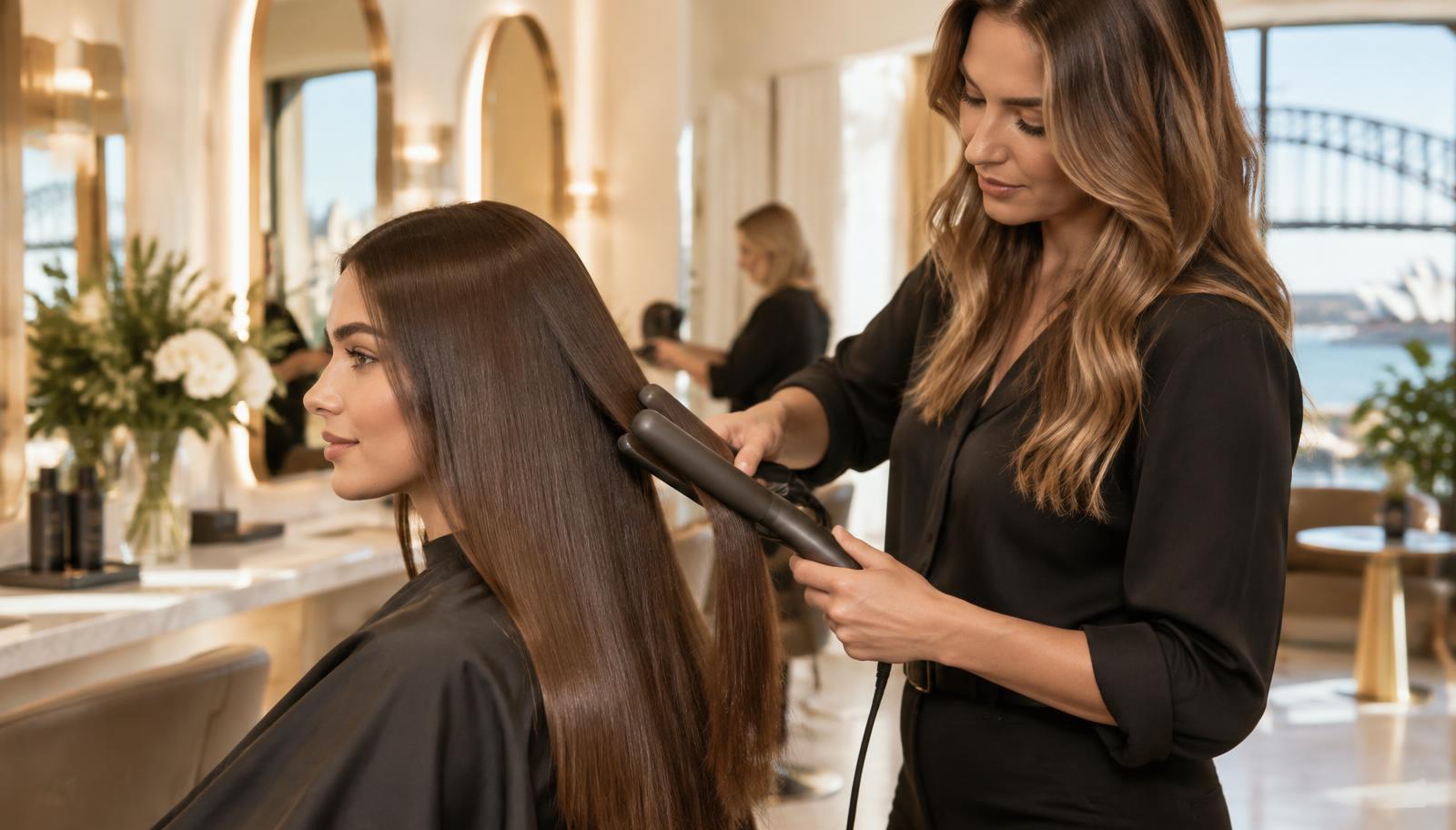
Nanoplasty — nanoplastia in Brazil — is a professional realignment treatment that reduces volume and frizz and restores shine. Low-molecular-weight actives such as amino acids and hydrolysed proteins enter the cortex and reorganise the cuticle; the fibre is aligned while they are mobile, and flat-iron heat fixes the new shape.
What happens inside the hair
Hair is roughly 90% keratin, held together by hydrogen, ionic and disulfide bonds. Frizz is a disorganised cuticle and a cortex holding an irregular shape. Nanoplasty works on both layers at once — which is why the result holds for months rather than weeks.
- Cleansing and opening the cuticle
- Penetration of the active complex
- Realignment while actives are mobile
- Thermal activation to fix the alignment
- Cooling and stabilising the fibre
The finish is a professional decision
Nanoplasty can take straight, wavy, curly or coily hair to 100% straight, or stop at a natural anti-frizz finish with movement, or define and elongate curls. The finish is chosen at consultation and controlled by processing and sealing — not limited by the chemistry.
What usually goes wrong
Most disappointing results come from the wrong diagnosis, processing cut short, or incorrect thermal sealing — temperature, passes and section size are variables, not preferences. Follow the manufacturer’s manual every time.
What should a first consultation establish beyond hair type?
A first consultation should establish the client's preferred finish, complete chemical history and realistic home-care commitment before a smoothing appointment is confirmed. Start with a practical question: what does the client want to do differently on an ordinary morning? Someone wanting a shorter blow-dry routine may have different priorities from someone wanting a consistently sleek appearance. Ask them to describe the volume, movement and curl they would like to retain rather than accepting 'less frizz' as a complete brief.
Record previous lightening, permanent colour, smoothing, home colouring and repeated heat styling, including approximate dates and which areas were treated. Hair at the crown may have a different history from the ends. Ask about extensions, swimming, outdoor work and usual washing frequency. These details help the hairdresser plan the assessment and explain what can reasonably be delivered.
Use reference photographs to agree on direction, not to promise an identical result. Photograph the starting condition with permission and record the agreed priorities in plain language. Explain that nanoplasty and keratin are names within the same category of professional smoothing, while the actual service must follow the chosen formula's instructions. Consultation notes should remain useful to another trained stylist, not just the person who conducted the conversation.
How does porosity change the treatment plan?
Porosity changes how the professional assesses application, handling and heat suitability across different areas of the head. Do not assume that all hair with the same curl pattern behaves alike. A client can have relatively resistant regrowth, more absorbent coloured lengths and very porous lightened ends. Map these zones during consultation and confirm your observations through the assessment required by the Vitta Gold Education Manual.
A strand test should represent the hair that creates the greatest uncertainty, not simply the easiest hidden section to reach. Where the history is mixed, assess representative areas rather than assuming one test describes the whole head. Record the strand's starting condition, the settings used and its appearance and manageability after the completed test. If the assessment does not support proceeding, explain why the appointment needs a different plan.
For bleached hair, colour placement matters as much as the overall shade. Face-framing highlights may need different handling from an unlightened underneath section. Never interpret a visually smooth test as permission to exceed the manual. The point is to establish whether the intended process is appropriate and repeatable, not to chase the straightest possible strand at any cost. Build additional consultation time into bookings with an uncertain history.
What should curly-haired clients understand before booking?
Curly-haired clients should understand that a smoothing service can change the appearance of their curl pattern, so the desired balance of smoothness and movement must be discussed explicitly. Ask how the client wears their hair most often: air-dried, diffused, stretched or blow-dried. A photograph of a polished salon finish does not show how that same head will behave after a home wash.
Discuss the difference between the finished appointment and the client's everyday routine. Explain that a result involving less visible volume may also change the shape they associate with their curls. Do not promise unchanged curl definition alongside substantial straightening. Assess shrinkage, density, porosity and previous chemical work together; curl appearance alone does not determine suitability or the permitted settings.
Where the client wants to keep a recognisably curly finish, check that their expectation is supported by the strand assessment and the exact protocol. Do not improvise by shortening processing or skipping prescribed stages. Agree on how results will be reviewed, ideally using comparable lighting and styling conditions. A client who understands the likely change can make a more informed decision than one shown only a dramatic before-and-after photograph. Document the agreed goal before product application.
What do the professional stages actually involve?
The professional stages involve controlled application, formula-specific processing, prescribed rinsing, complete drying, thermal work and finishing rather than a single universal technique. The working parameters are processing for 15–60 minutes depending on hair type and formula, rinsing 60–100% of the product, then blow-drying until the hair is 100% dry. These ranges are not interchangeable options; use the Vitta Gold Education Manual to select the exact procedure.
Flat-ironing falls within 8–15 passes at 180–230°C, with the precise combination determined by the manual and professional assessment. The highest temperature and highest pass count are not an automatic pairing. Section size must allow the stylist to work evenly and maintain control, particularly around dense areas, the nape and the hairline. Residual moisture should be resolved before thermal work begins.
Conditioner seals the cuticles as part of the prescribed finish, while a mask and serum support shine. Follow the manual for their sequence and use rather than combining stages for convenience. Explain these stages briefly during consultation so the client understands why the booking needs uninterrupted time. A rushed rinse or incomplete blow-dry is not a useful way to shorten an appointment. Home care then maintains the finished result between visits.
How should Australian lifestyles shape aftercare advice?
Australian aftercare advice should reflect the client's actual exposure to humidity, chlorine, salt water and UV rather than relying on one generic product recommendation. A Brisbane client who swims before work has a different maintenance routine from a Melbourne client who washes less frequently and spends most days indoors. Ask about these habits before choosing a realistic home-care plan.
Recommend low-sulphate home care with conditioner, plus a mask and serum used according to their directions. Explain how much to apply for the client's length and density, where to distribute it and how to rinse thoroughly. More product does not automatically produce a better finish. Give particular attention to porous ends, which may need a different amount from the roots without requiring a completely different routine.
Once swimming is permitted under the exact protocol, minimise unnecessary chlorine and salt-water exposure and rinse with fresh water afterwards. Discuss shade, hats and a suitable hair product labelled for UV protection without suggesting that smoothing makes hair resistant to the environment. Humidity may still affect the appearance of the style. A simple written plan, matched to the client's habits, is more useful than promising that the service eliminates the need for styling or maintenance.
What should a nanoplasty quote include?
A nanoplasty quote should include the professional assessment, expected chair time, product allowance and clearly described finish, with any home-care purchase identified separately. For planning purposes, a typical illustrative Australian menu might span AUD $250–$600 for many appointments, with very long or dense hair potentially quoted above that range. This is not a verified national average or a guaranteed local price.
Length alone is an incomplete pricing guide. A shorter, very dense head can require more sectioning and thermal work than longer, finer hair. Review density, porosity, previous colour and the time needed for a thorough consultation and strand test. Explain any additional time or product allowance before taking a deposit. If the final quote depends on an in-person assessment, say so clearly in the booking description.
Avoid presenting a premium price as a promise of permanent straightness. Results last typically three to six months, with individual variation in regrowth, washing habits and maintenance. Describe what is included in that day's appointment, whether a review is offered and which retail items are optional. A transparent written quote helps the client compare complete services rather than headline prices. It also gives reception a consistent explanation when a client asks why their appointment differs from a friend's.
How can salons explain results without overpromising?
Salons can explain results responsibly by separating the immediate styled finish, everyday manageability and expected maintenance period. A freshly finished photograph shows what the hair looks like after professional styling; it does not prove how every client will look after air-drying. Describe the goal in observable terms such as reduced visible frizz, a smoother appearance or easier section-by-section styling, matched to the agreed consultation.
Set an expectation of typically three to six months rather than a fixed expiry date. Explain that new growth retains its own characteristics and may become more noticeable before the lengths need another service. Clients should know that a change near the roots does not necessarily mean that the whole treatment has disappeared. Encourage them to contact the salon for an assessment rather than automatically booking another full application.
Use review questions that produce useful information: how long does the morning routine take now, which areas remain difficult, and what happens after washing? Check the answers against the original goal and documented protocol. If expectations and observations differ, inspect the hair and routine before deciding what to do next. A careful explanation builds professional confidence without making claims about guaranteed straightness, universal suitability or a finish that needs no ongoing care.
Nanoplasty in Australia
Vitta Gold professional products are supplied in Australia by Elasta, our official local partner — create a professional account, talk to the team on live chat and order with local stock.
Frequently asked questions
Is nanoplasty permanent?
It is long-lasting, not permanent: results fade gradually over three to six months as hair grows and is washed.
Does nanoplasty straighten curly hair?
Yes — it can reach a 100% straight finish on curly and coily hair, or keep defined curls if that is the goal.
Is nanoplasty formaldehyde-free?
Yes, with a compliant professional line. Verify with the safety data sheet.
Should clients arrive with photographs of their usual hair?
Yes. Photographs showing the hair after an ordinary wash can help distinguish its everyday behaviour from a recent salon blow-dry. Ask for examples of both the current routine and the desired finish. Use them alongside an in-person assessment, not instead of a strand test or chemical history.
Can two people with similar curls receive different service plans?
Yes. Similar-looking curls can differ in density, porosity, previous lightening and response during assessment. The exact protocol comes from the Vitta Gold Education Manual and the professional's findings, not a visual curl label. Record those differences so future appointments can be planned consistently.
Does a glossy finish mean home care is unnecessary?
No. Gloss at the appointment does not replace maintenance. Low-sulphate home care, conditioner, appropriate mask use and a suitable serum help maintain the finish. Advice should also address swimming, heat styling and outdoor exposure so the routine remains practical for the client's lifestyle.
Should the salon guarantee the result shown in a reference image?
No. A reference image helps explain a preference, but its starting condition, lighting and styling may differ substantially. Agree on a realistic goal after assessing the client's own hair. Record what is expected without promising an identical texture, shine level or maintenance period.
What should a client bring to a consultation?
Bring an approximate colour and smoothing history, details of usual shampoo and styling products, and information about swimming or frequent outdoor activity. Mention any uncertainty about earlier services. This gives the hairdresser a stronger starting point for assessment, testing, timing and a written quote.